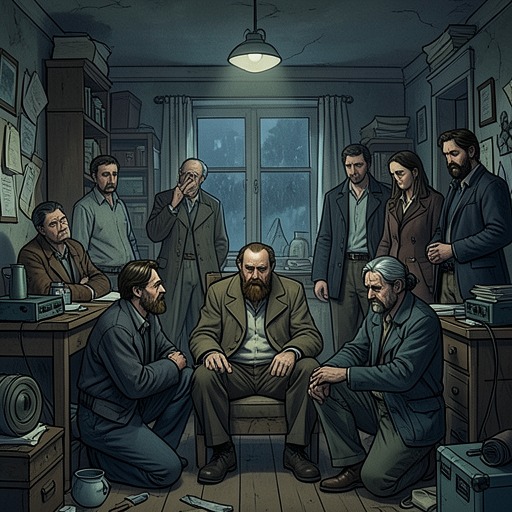
Pavel Smerdyakov
The Brothers KaramazovPavel Smerdyakov is the household servant whose death and alleged confession become crucial to the trial of Dmitri Karamazov. He does not appear in court: an official police statement reports that he has died by suicide. Yet his absence sharpens the central dispute over who killed Fyodor Pavlovich. Ivan Karamazov says that Smerdyakov confessed to the murder and implicates Ivan himself as the person who incited it, leaving the court to weigh a dramatic accusation against a dead man’s note and contested testimony about his character.
Identity and Position in the Trial
Smerdyakov enters the trial record through two linked facts: he is dead, and he had been the person Ivan says killed their father. When the police statement is presented, the news causes a stir and whispers among the audience; many have not heard that he has died. His death is therefore not background information but a disclosure that changes the terms of the proceedings. The court can no longer hear from him, and any claim about what he did or said must come through surviving witnesses and documents.
That absence gives Smerdyakov an unusual presence in the trial. His name recurs as the proposed answer to the murder, while his own account is available only indirectly. The prosecution and defense interpret the same circumstances differently: one side can invoke his death as evidence of weakness and melancholy, while the other treats his alleged confession as grounds for rejecting Dmitri’s guilt. The trial makes him both a participant in the events under examination and an object of competing narratives.
The Reported Confession
The most consequential account of Smerdyakov comes from Ivan. Asked how certain money came into his possession, Ivan answers that he received it from Smerdyakov the previous day and says he was with him shortly before Smerdyakov hanged himself. Ivan then names Smerdyakov as the killer of their father and adds that he himself incited the crime. In the courtroom, this is not a simple exoneration of Dmitri: Ivan’s claim redirects the accusation while placing Ivan under suspicion of moral involvement.
The timing gives Ivan’s statement its force. He says that the meeting with Smerdyakov occurred on the day before his death, making the reported confession the last account attributed to the alleged murderer. But because Smerdyakov cannot confirm it, the claim reaches the court through Ivan alone. The evidence thus distinguishes between what Ivan asserts he heard and what the trial can independently establish. Smerdyakov’s alleged confession is a turning point in the interpretation of the case, not a testimony delivered by Smerdyakov in person.
Death and the Note
Smerdyakov’s death is presented to the court as a suicide, and the prosecution describes it as occurring in a fit of melancholy brought on by illness and the catastrophe surrounding the case. The prosecution also refers to a note written in Smerdyakov’s peculiar language, in which he says that he is destroying himself of his own will and inclination so that blame will fall on no one. The note’s stated purpose becomes part of the dispute: it can be read as an attempt to prevent blame, but the prosecution argues that its wording does not identify Smerdyakov as the murderer.
The defense counters the inference drawn from the note and from Smerdyakov’s death. Its argument is that, if Smerdyakov had wanted to protect Dmitri, he would have had reason to conceal or distort the facts; instead, the defense contends, the note does not make the direct declaration that would have settled the matter. This reasoning does not supply a second eyewitness account. It exposes how the same silence—the absence of a confession in the note—can be used to support opposing interpretations of Smerdyakov’s intentions and guilt.
Character in Dispute
Smerdyakov’s character is itself contested in court. The prosecutor has offered a subtle and skillful portrait of him but depicts him as weak in health and character. The opposing speaker, who says he visited and spoke with Smerdyakov, accepts his poor health but rejects the description of him as weak in spirit. This disagreement matters because the trial’s account of the death depends partly on whether Smerdyakov is imagined as too frail to act decisively, or as capable of a deliberate crime and a consequential confession.
The evidence does not resolve this disagreement through a fresh encounter with Smerdyakov; it presents competing judgments made by people who knew him. His characterization consequently functions as part of the case rather than as settled biography. The question of his strength or weakness is tied to the credibility assigned to his alleged confession, his death, and the note he left behind.
Narrative and Legal Significance
Smerdyakov’s death arrives at a moment when the trial is assembling facts that seem suggestive but remain inconclusive. The defense explicitly places his suicide on the eve of the proceedings among the circumstances that raise suspicion, alongside the disputed account of his illness. Those facts direct attention toward him without, by themselves, proving the defense’s version. The gap between a pattern of suggestive circumstances and a conclusive demonstration is central to his role in the trial.
As a result, Smerdyakov becomes the absent center of a courtroom contest over evidence, responsibility, and interpretation. Ivan’s accusation supplies a named alternative killer but also confesses Ivan’s own incitement; the suicide note records no direct admission of murder; and testimony about Smerdyakov’s character divides rather than settles opinion. His ending closes off the possibility of his own testimony while making every surviving statement about him more consequential. The trial must judge Dmitri through evidence that repeatedly points beyond him, yet never allows the accused man himself to answer the dead servant’s alleged confession.